Featured Question
How do I operate my three point lock?
To lock the door, lift the door handle up. Then turn the key or deadbolt to lock the door. To unlock the door, turn the key or deadbolt and push the handle down.
-
Storm Doors
-
Storm Windows
-
Retractable Screens
-
Porch Windows
Storm Doors
-
Closers (Pneumatic)
-
How do I adjust my door to make it close faster or slower?
-
If your door has two closers, unhook one closer to adjust one closer at a time. Turn the adjustment screw or knob (varies by model) 1/4 to 1/2 turn at a time, until you've achieved your desired closing speed. Turn it counter-clockwise to increase speed, and clockwise for a slower speed.
-
How do I hold my storm door in the open position?
-
Some models have a hold-open button on one of the closers. This button is typically installed as the bottom closer, and the button should be pointing up. Open the door to the desired position and tap the button to hold the door in position. To close the door, slightly push the door further open and release. The door will then close on its own.
To hold a storm door open with a standard closer, open the door to the desired position and slide the hold open washer until it rests against the closer tube. To close the door, open the door a bit more to take pressure off the hold open washer. Slide the washer back past the knobs on the rod and against the jamb bracket. Let go of the door and it will then close on its own.
-
My primary entry door hits against the storm door closer. How can I correct this?
-
Move the closer bracket nearer to the storm door. If it still hits, you can try adding shims under the side and top mounting rails to move the storm door further away from the entry door.
-
Why does my closer make a popping noise?
-
The door closer bracket may not be securely attached to the door. If the bracket screws are loose, the closer can move side to side creating the popping noise when the door opens or closes. Securely tighten the screws. If the screw holes are stripped, you can use larger diameter screws to hold the bracket in place.
-
Handles
-
Why do I have to lift up on the handle to open my door?
-
Needing to lift up indicates the handle set was installed upside down. Referring to your original instructions, remove the handle and lockset and reverse them. You may also need to reverse the latch assembly.
-
My handle came off the door. What do I do?
-
Many handles are held in place by a set screw, and the set screw likely came loose. Reattach the handle, and firmly tighten the set screw. If the set screw is stripped and cannot be tightened, the handle will need to be replaced.
Some handle sets require a D-Clip on the back side of the trim plate for the outside handle, which may have come loose. With the outside handle inserted through the outside trim plate, slide the D-Clip through the grooves on the end of the handle. Insert the spindle into the handle, and complete the handle installation.
-
How do I operate my three point lock?
-
To lock the door, lift the door handle up. Then turn the key or deadbolt to lock the door. To unlock the door, turn the key or deadbolt and push the handle down.
-
What can I do if my deadbolt is stuck or not working?
-
The storm door deadbolt and latch side rail are likely misaligned, which can prevent the deadbolt from retracting.
To unjam the deadbolt, remove the latch side rail installation screws. This will loosen the tension on the deadbolt allowing it to retract and the door to open. Once the door is open, operate the handle and turn the deadbolt. If either does not operate when the door is open, the hardware needs to be replaced.
If the handle set and deadbolt move freely when the door is open, the deadbolt may be hitting the edge of the strike plate. Adjust the strike plate to allow the deadbolt to move freely. To determine in which direction and how much to move it, apply some lipstick to the edge of the deadbolt. When the door is closed, engage the deadbolt all the way. Open the door, and if there is a lipstick mark on the latch rail or strike plate, adjust as needed. Wipe the plate clean, and repeat the test until the deadbolt engages freely and doesn’t leave a mark.
If there is not lipstick on the strike plate, but there is a mark on the back surface of the deadbolt hole, the deadbolt hole in the door frame needs to be deepened with a chisel.
-
Why does the button stick on my push button handle?
-
There may be too much tension in the handle screws; try loosening them. Or the spring may be installed backwards. Remove the handles and confirm that the narrow end of the spring is inserted into the outside handle, and the wide end is against the door. Reverse if needed, and reattach handles.
-
How do I clean my brass handle set?
-
Several handle sets are solid brass. These handle sets have a clear coat finish to protect the brass. Over time, the clear coat finish can wear through or be compromised by nicks from rings and keys, exposing the solid brass to the elements. Unprotected brass will tarnish under this exposure. Polish the brass using a brass cleaning product, according to package instructions.
-
Screens
-
How can I adjust my Screen Away® screen so that it doesn’t blow out or push out on the sides?
-
The screen is designed to blow out in heavy winds or when pushed on to prevent damage to the screen. To reset the screen into the sides, slowly lower the glass all the way to the bottom. Then raise the glass all the way to the top. Slowly lower the glass again, and the screen should be reset.
-
Why does the glass panel on my Screen Away® drop a bit when I release it?
-
When not locked into place, it is normal for the top glass panel to drop 1–3 inches. If the sash consistently drops more than 3 inches, there may be an issue with the screen tension. Contact our customer care department.
-
What if my glass on my Screen Away® will not stay up at the top?
-
First, verify the black shipping clip has been removed from the screen cover. Then, ensure the latch mechanism is engaged. Many Screen Away doors have a latch built into the top of the bottom glass panel, located in the middle of the door.
Other doors have a latch built into the handle at the top of the top operating glass panel. This handle needs to be installed during the door installation.
Install Latch Handle
-
What should I do if the screen will not retract?
-
The screen balance mechanism may need to be reset. Lower the glass panel about half way. Open the door, and place a hand on each side of the screen material-one inside and one outside of the door. Pull down on the screen about six inches and then release it. The screen should snap up, resetting the tension of the rolling mechanism.
The screen roll may have come out of its brackets. Remove the cover that is over the screen roll. The screen cassette should be seated in a bracket on each end. Adjust the screen if needed.
-
How do I install the screen in my full view door?
-
First, make sure that only the glass or the screen, but not both, are in the door at one time. Hold the screen in the door opening while inserting the retainer strips in place. Start at the top of the door and hold the retainer at about a 45 degree angle, with the edge with writing on it facing you. Slide it into the door channel in front of the screen; it should not go in between the screen and the door frame. Working your way down the door, slide and snap the retainer into the track until the markings are no longer visible, applying pressure as you go. When you get to the end, you will hear a snap as the last portion of the retainer goes in. If you find the fit to be tight, spray glass cleaner on the retainer strip to help it slide in the channel.
-
Can the half screen in my door be installed at the top or bottom?
-
Glass
-
How should I clean my high performance Low-E glass?
-
Glass cleaners may be used with lint-free soft cloth. To avoid streaks, do not try to completely dry surface. Never use any type of scraper or abrasive cleaner because they may cause damage to the coated surface.
-
How do I install the glass in my fullview door?
-
First, make sure that only the glass or the screen, but not both, are in the door at one time. Hold the glass firmly in the door opening while inserting the retainer strips in place. Start at the top of the door and hold the retainer at about a 45 degree angle, with the edge with writing on it facing you. Slide it into the door channel in front of the glass panel; it should not go in between the glass panel and the door frame. Working your way down the door, slide and snap the retainer into the track until the markings are no longer visible, applying pressure as you go. When you get to the end, you will hear a snap as the last portion of the retainer goes in. If you find the fit to be tight, spray glass cleaner on the retainer strip to help it slide in the channel.
-
I want to swap the glass back in on my fullview door, but it no longer fits. What do I do?
-
The metal trim on the edge of the glass panel may be coming off. Gently tap the metal trim back in place with a rubber mallet. If the metal trim and the rubber boot have come off too far to tap back on, first tap the metal trim OFF the glass. Reset this rubber boot on the glass edge and then tap the trim back on. Use care not to carry the glass panel by the metal trim alone.
-
General Operation
-
How do I install the screw cover strips?
-
Fit the straight, outer leg into the mounting rail first, and then snap in the inner, hooked leg. Start at the top end, and slide your finger down the strip while pressing firmly.
If one or both legs are damaged or bent, the screw cover strips need to be replaced.
-
How wide will my door open?
-
Your door is designed to open to about 80 degrees, which helps prevent the hinges from overextending and being damaged.
-
Why won’t my storm door close?
-
You likely need to adjust the closer.
Other possibilities:
- The storm door's bottom expander sweep may be dragging on the threshold. Loosen the two expander screws and raise the expander so that the rubber sweep just touches the top of the threshold. Retighten the screws.
- There may be a pocket of air pressure between the primary door and storm door. To create an escape route for the air, try raising the storm door expander or leaving the storm door window slightly open.
- The hinge rail screws may be too tight. Loosen the hinge rail installation screws a ¼ turn to relax the tension.
-
How can I stop my door from squeaking when it opens and closes?
-
If your door is new, the hinges could be tight until they receive some use. Lubricate the hinges with silicone spray or 3-in-1 oil.
Other possibilities:
- The inside hinge rail screws could be too tight. Loosen them a ¼ turn to relax the tension.
- The door opening may be out of square, which can happen as a home settles. You will need to adjust the door opening square and plumb so the storm door can perform as designed.
-
Why does my door leak?
-
If water is coming in around the window opening, the drainage holes (also known as weep holes) may be blocked. Inspect and clean the drainage holes, which are located on the outside of door just below the window area.
If your door has a full screen and both glass panels move up and down, the narrower of the two glass panels should be at the top and the wider one at the bottom.
You’ll gain top performance with the top glass panel in the outside track, overlapping the bottom glass panel in the inside track. Reverse the panels if needed.
In multi-vent® doors, keep the screen installed for the tightest seal.
Caulking behind the top drip cap and the mounting rails can prevent water or air from leaking around the edges of the door.
You may find water in the bottom expander after a rain. This occurrence is normal, and the water will naturally drain to the outside when you open the door.
-
Where do I find the registration number for my door?
-
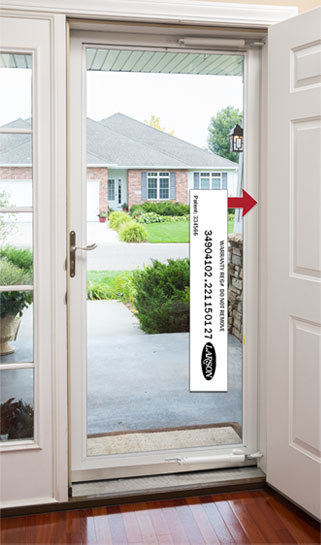
The registration number can be in several locations depending on the manufacturing date. Look for a sticker either on the edge of the door on on the hinge z-bar as shown below.
-
Hidden Closers (Hydraulic)
-
Why isn’t my door closing all the way?
-
There are pads in the top mounting rail. In order for the closer to operate correctly, they need to be separated. To do that, just push the door open to 90 degrees and tighten the set screw in the pad closet to the hinges. Then just push the door closed to disconnect the pads.
Make sure you have removed the hold open pin.
-
Why does the door bounce back open when it’s closing?
-
The tension may not have been set before installing the closer in the door. You will need to remove the closer and reinstall it starting with step 8a of the door installation instructions.
-
Do I have to pull hard to disengage the hold open clip?
-
It may be a little difficult at first but it should get easier the more it is used.
-
How do I adjust the closing speed?
-
There is a flat head screw on the top of the closer. Turn it to the right until it is tight. Then turn it left one full turn. Test the speed. To increase it more, turn it ¼ turn and test. Repeat until the door is closing at your desired speed.
-
Why won’t the closer arm line up with the Slider Pad?
-
Verify your hinge side as viewed from the exterior. Make sure the correct letter is facing up on the arm. ‘R’ for right hinge and ‘L’ for left hinge.
Ensure the arrow on the top of the closer is pointing towards the hinge side.
Make sure the closer pin is installed.
Check the arrows on the slider pads. They must be pointed toward the hinge side.
Storm Windows
-
General
-
What can I do if my screen is falling out?
-
The screen may be in the wrong track. For triple track models, the screen needs to be on the inside track (closest to the interior of the house).
-
How can I get the finger pulls unstuck?
-
Apply some lubricant to the finger pulls. If that doesn’t work, the frame of the glass panel may be bent and need to be replaced.
Contact our customer care team to order replacement parts.
-
Why are my windows leaking?
-
First, ensure that the glass panels are properly installed and secure in their tracks. For added weather protection, you can caulk along the sides and top of the frame. DO NOT caulk bottom.
Retractable Screens
-
General
-
How can I get the magnetic strips to hold the screen cassette closed?
-
Clean the magnets with mild soap and water. This will remove any grime that may prevent the two magnets from sticking together. Remove any debris in the bottom guide. And ensure the opening is square and the magnets on the pull bar and latch rail are aligned when closed. To change the alignment of the latch rail, loosen the installation screws and shim as needed.
-
What can I do about my weatherstripping bunching up?
-
Pull the weatherstripping tight and crimp the channel on both ends with pliers.
-
My Inspire® screen is not retracting all the way. What can I do?
-
Ensure the cassette is pushed all the way down onto the sill. The caterpillar tracks on the screen need to rest on the bottom guide. Check the top guide for debris.
-
What can I do if my Inspire® screen has been pushed out?
-
Slowly retract the pull rail back to the cassette and manually insert fabric back into the guide.
Porch Windows
-
Screens
-
What if my screen loses tension?
-
The screen balance mechanism may need to be reset. Try resetting the screen by giving the window a quick tug (up and down motion).
-
Can the screen be replaced?
-
Yes, both top and bottom screens can be replaced without removing the entire unit.
-
Can I use only the top or bottom screen?
-
The dual-sash window design includes a quad pulley balance system; meaning the top and the bottom windows will always move simultaneously.
-
Why is my screen baggy?
-
The opening may need to be squared up. Shim the opening to be square and plumb until “Bags Disappear” Some waviness is normal.
-
Glass
-
Why does my window bypass the sash lock?
-
Make sure all shims are within 1” of each screw hole. It’s important that the opening is square and plumb.
-
Why is my glass getting foggy?
-
That is likely condensation. Scenix windows are designed for three season rooms that do not have a heat source.
-
Why is my window difficult to open?
-
Move the window slowly. There is nearly 10-15 pounds of pressure on the balance system. By operating the window slowly the balance system has time to catch up with the weight of the window.
-
General
-
Is a railing or knee wall needed if the porch/deck is elevated above grade?
-
If the porch or deck is elevated, a knee wall or railing is recommended. Please check with your local city building codes for specific size requirements as it can vary on how high above grade the porch/deck is located.
-
Why is my window leaking?
-
- Verify the tape has been removed from the weep holes and they are clear of any debris. The weep hole covers (louver) should move freely.
- All trim work should be caulked and the sill should slope towards the exterior for proper drainage.
- The front face of the panel should be flush or extend past the outermost surface of any framework to ensure proper drainage.
NOTE: Storm and porch Windows have been discontinued. All mention of these products are posted with the intent to support existing customers who have purchased these products prior to discontinuation. We apologize for any inconvenience.